

What Drives the Cost of a Stationary Dock on Lake Minnetonka
Understanding Stationary Dock Cost on Lake Minnetonka
Stationary dock cost on Lake Minnetonka is not a single number you can look up and apply to every property. It is the result of several decisions that a homeowner makes, combined with the physical conditions of the shoreline itself. Tonka Built is a dock manufacturer in Minnetrista, MN, and pricing on any stationary dock is handled through a quote rather than a published figure. That approach exists because no two shoreline properties, and no two homeowners, want exactly the same thing. Understanding the variables that go into a quote helps you ask better questions and compare options with more confidence.
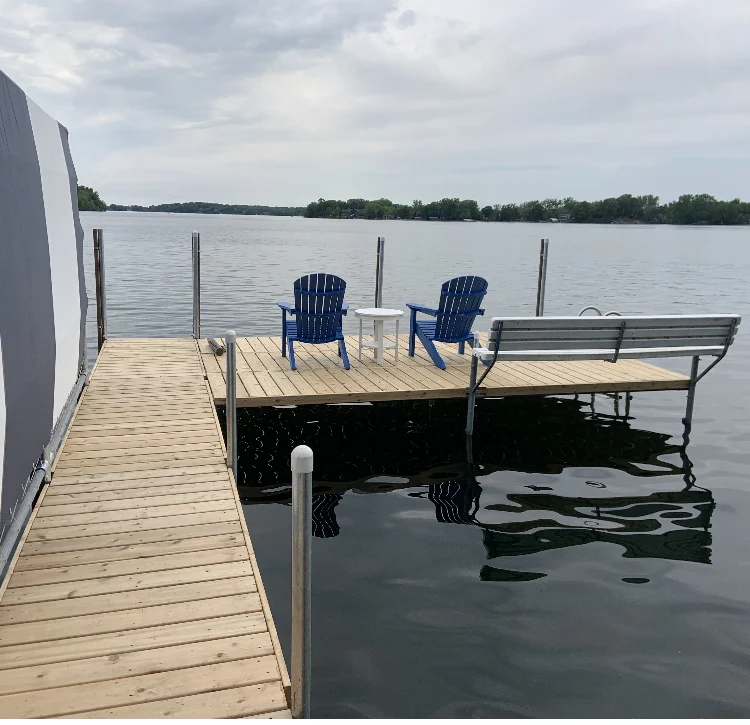
This article walks through the main factors that shape what a stationary dock costs to build and install, so you know what to look at before you request pricing.
Length and Width Set the Foundation
The most basic driver of cost is simply how much dock you need. Length and width determine how much material goes into the structure, how much labor is required to assemble it, and how much hardware is needed to keep it stable. A longer dock is not just a matter of adding a few extra feet. Depth, bottom conditions, and how far out the water stays shallow can all affect how much structure is needed to reach usable water.
Width matters just as much as length, though it gets less attention. A narrow dock meant for walking out to a boat is a very different project than a wider dock meant to support seating, gathering space, or multiple activities at once. Before you request a quote, think through how you actually use your dock day to day. Do you need room for chairs? Do multiple people use it at the same time? Is it primarily a path to the water or a destination in itself? The answers shape both the length and width you should ask about.
- How far does the water stay shallow near your shoreline?
- Do you want a straight dock or one with an additional section?
- How many people typically use the dock at once?
- Is the dock mainly functional or also a gathering space?
Decking Choice Changes the Look and the Price
Decking is one of the more visible decisions a homeowner makes, and it plays a real role in overall cost. Different decking materials carry different price points, and the choice often comes down to a balance between appearance, feel underfoot, and budget. Some homeowners prioritize a clean, uniform look. Others care more about how the surface feels when walking barefoot. Still others are focused on how the decking will hold up to the kind of use their family puts it through.
Because these are tradeoffs rather than one-size-fits-all answers, it is worth asking yourself a few questions before comparing decking options.
- What matters more to you, appearance or underfoot feel?
- How much direct sun does your dock typically get?
- Are you trying to match or complement existing outdoor finishes on your property?
- Will the dock see heavy daily use or lighter, occasional use?
None of these questions has a universally right answer. They simply help you figure out which decking option fits your priorities, which in turn affects where your project lands on the pricing spectrum once you request a quote.
Accessories Add Function and Cost
Beyond the core structure, accessories are where many homeowners customize a stationary dock to fit their specific routine. Ladders, cleats, benches, and other add-ons all contribute to the final scope of a project. Each accessory serves a purpose, but each one also adds to the labor and materials involved, which is why they factor into the overall quote.
A useful way to approach accessories is to separate what you need from what you want. A ladder for swimming access might be essential for your family. A bench might be a nice addition but not a priority. Walking through your own use case, rather than defaulting to every available option, helps keep the project aligned with what actually matters to you.
- What activities happen on or around your dock regularly?
- Which accessories solve a real need versus simply add convenience?
- Are there accessories you can add later rather than all at once?
- Does your household include swimmers, anglers, or guests with different needs?
Shoreline Conditions Influence Everything Else
Perhaps the least visible but most influential factor in stationary dock cost is the shoreline itself. Every property on Lake Minnetonka has its own combination of depth, bottom composition, slope, and exposure. These conditions affect how a dock needs to be configured to sit securely and function well over time. A shoreline with a gradual slope and firm bottom presents different requirements than one with a steep drop-off or softer bottom conditions.
Because shoreline conditions are specific to each property, they cannot be generalized into a simple rule. This is part of why Tonka Built treats every project as a quote rather than a fixed price list. A homeowner with a straightforward shoreline and a homeowner with a more complex one are not comparing the same project, even if the dock dimensions look similar on paper.
If you are trying to estimate your own project before requesting a quote, it helps to document what you already know about your shoreline.
- How steep or gradual is the slope from your shoreline into the water?
- What does the lake bottom look like near your dock: sand, rock, or something else?
- Has your shoreline changed noticeably over time?
- Are there any obstructions or unusual features near where the dock will sit?
Why Pricing Is Quote Only
Given how many variables go into a stationary dock, from length and width to decking, accessories, and shoreline, it makes sense that pricing is handled on a quote basis rather than a published number. A quote allows length, width, decking choice, accessories, and shoreline conditions to be considered together, rather than forcing a one-size-fits-all price onto properties that are anything but uniform.
Tonka Built manufactures its docks in-house in Minnetrista, and its own crew works within about an hour of Lake Minnetonka, with dealers serving customers beyond that distance. Wherever you are located relative to the lake, the same principle applies: an accurate number comes from a conversation about your specific property and preferences, not a generic price sheet.
Before you request a quote, take some time to think through the questions raised in this article. Knowing roughly how you want to use your dock, what decking qualities matter most to you, which accessories are must haves versus nice to haves, and what you already know about your shoreline will help you have a more productive conversation and get a quote that reflects your actual project.