

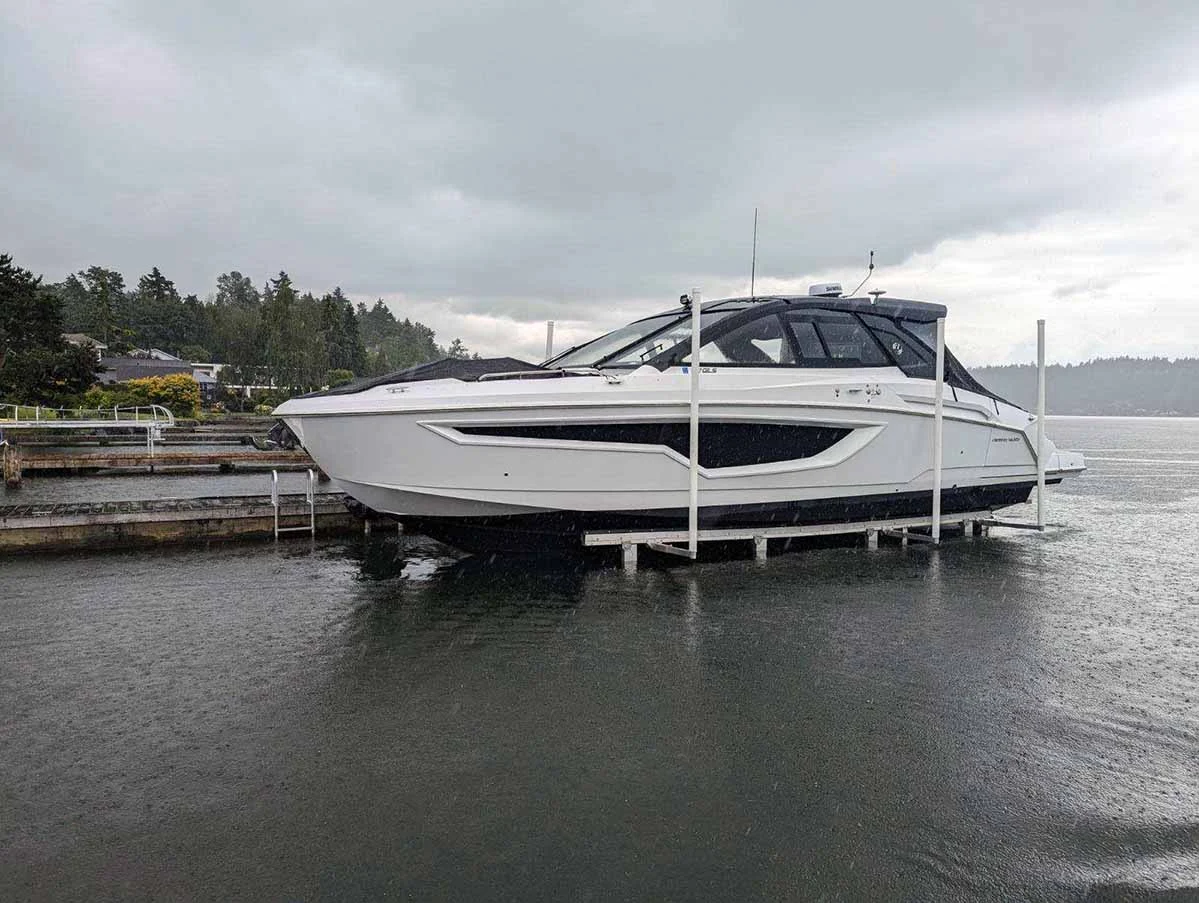
RGC Flex Hydraulic Lift vs Vertical Hydraulic Lift on Lake Minnetonka
The Flex Hydraulic Lift (HL) and the Vertical Hydraulic Lift (HVL) are the two hydraulic lifts RGC builds and Tonka Built sells on Lake Minnetonka. Both are hydraulic, both handle the shorelines and lake bottoms around Minnetonka, and the real difference is how the cradle moves.
Tonka Built is an authorized RGC dealer. RGC builds the lifts in its own manufacturing shop, and Tonka Built sells them, assembles them, installs them and services them on Lake Minnetonka. The docks are the other way round: Tonka Built manufactures its own stationary steel and aluminum and steel floating dock systems in Minnetrista.
What is the difference between an HVL and a Flex hydraulic lift?
| Vertical Hydraulic Lift (HVL) | Flex Hydraulic Lift (HL) | |
|---|---|---|
| Motion | Straight up and down | Cantilevers back to lower, forward to raise |
| Mechanism | Traditional cables and frame, powered by a hydraulic ram instead of a winch drum | Underwater hydraulic cylinders |
| Why owners choose it | Faster operation and longer cable life than a winch drum lift | Fewer moving parts and a sleek look at the dock |
Which lift fits which boat?
Capacity and cradle type are matched to the published weight and hull of your boat. Pontoons and tritoons use pontoon cradles and bunk setups built for that hull, and heavier wake boats sit in a higher capacity class. Tonka Built sizes from the manufacturer’s specifications rather than estimating.
Does the lake bottom decide it?
No. Both the HVL and the Flex work on the uneven, rocky and soft bottoms found around Lake Minnetonka. Water depth at the slip, whether power is available at the dock, and how the boat is used matter far more than the bottom itself.
Who buys these lifts?
Individual lake homeowners are most of it. Marinas and homeowner associations buy them too, but the everyday customer is a family with one or two boats on a private shoreline around Minnetonka, Wayzata, Excelsior, Orono, Mound or Spring Park.
What is included when you buy either lift
Tonka Built quotes the lift, the cradle and the bunks or pontoon brackets for your hull, delivery, assembly, installation at the slip, and the electrical connection. Canopies, guide posts, bow stops and remote drives are listed as options so the price matches the setup you want rather than a package you did not ask for.
Maintenance over the life of the lift
An HVL keeps cables in the system, so cable condition is still part of its annual check, but the hydraulic ram carries the load instead of a winch drum, which is why cable life is longer. The Flex has no lifting cables at all: its underwater cylinders do the work, so the check list is hoses, seals and the power unit. Both are serviced by Tonka Built for the lifts it sells and installs.
Frequently asked
Is a Flex lift quieter or slower than an HVL?
Both cycle quickly and are operated with a control at the dock. The visible difference is the motion: the HVL rises straight, the Flex swings back and down.
Which one looks better at the dock?
Owners who care about the sight line from the house usually prefer the Flex, because the cantilever design puts less structure above the water.
Can either lift take a canopy?
Yes. Canopy options are available for both, and the canopy choice affects the frame specification, so it belongs in the original quote rather than as an afterthought.
Which lift do most Lake Minnetonka homeowners buy?
It splits by boat and by shoreline rather than by preference. Heavier pontoons and tritoons often land on the HVL, while owners with a clean sight line and a straightforward slip often prefer the Flex.
Who installs and services them?
Tonka Built, on Lake Minnetonka and the surrounding lakes, plus the dock dealer network for the wider area. RGC manufactures the lifts, and the dealer network carries the same warranties.
How Tonka Built quotes an RGC lift
- Boat make, model and year set the capacity class from the published specification.
- Hull type decides the cradle: pontoon and tritoon setups differ from a traditional hull.
- Depth at the slip and available power narrow the model.
- Canopy and accessory choices go in the original quote because they affect the frame.
RGC Marine manufactures the lift. Tonka Built assembles it after delivery, installs it at the slip and services it in the seasons that follow, which is the part of the purchase that is local.
Capacity classes at a glance
| Boat | Typical direction |
|---|---|
| Runabout or fishing boat | Either model in a lower capacity class, sized off the published weight |
| Wake boat with ballast | Higher capacity class, cradle set for the hull |
| Pontoon or tritoon | Pontoon brackets and cradle, commonly an HVL |
Capacity is never set by eye. We take the manufacturer’s published weight for the boat, add fuel, gear and a hard top or canopy where there is one, and choose the class above it if the numbers land close to a limit.
Where can you buy an RGC hydraulic lift?
Tonka Built sells and installs the RGC lineup around Lake Minnetonka, and its dock dealer network extends the same products and warranties east to White Bear Lake, south to Prior Lake and west to Alexandria and Detroit Lakes.