

Choosing Boat Lift Capacity for Your Minnetonka Dock
Choosing the Right Boat Lift Capacity for Your Lake Minnetonka Dock
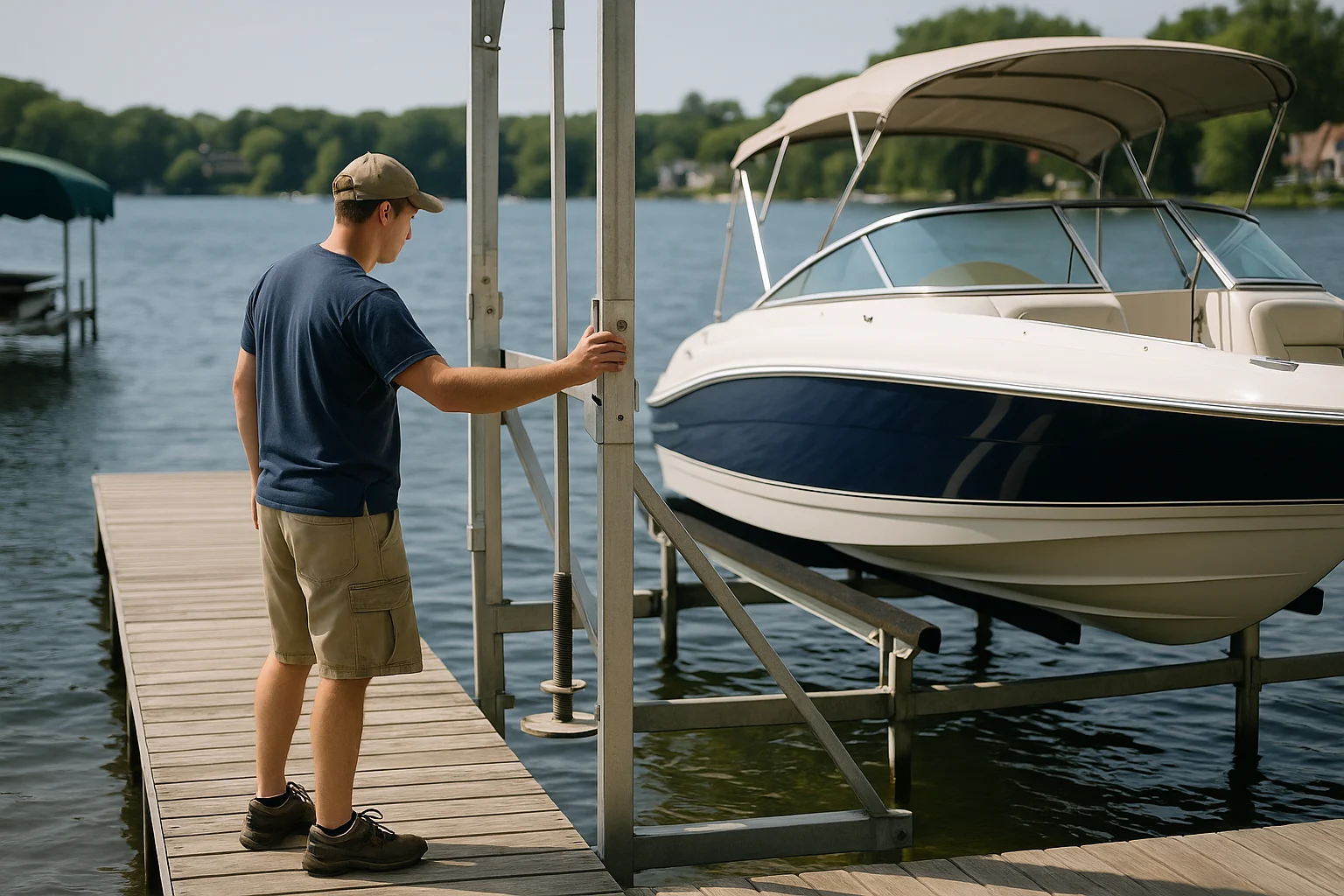
Picking the correct boat lift capacity is one of the most consequential decisions a Lake Minnetonka homeowner makes when outfitting a dock, and getting it wrong is an expensive mistake. Undersize a lift and you risk motor strain, cable failure, or a boat that never fully clears the waterline during freeze-thaw cycles. Oversize it and you are paying for lift infrastructure and dock reinforcement you do not need. Tonka Built has spent more than 20 years fitting boat lifts to boats and shorelines from Wayzata to Mound, and capacity miscalculation is the single most common issue we see on service calls for lifts installed by other outfits.
This guide walks through how to calculate the right lift capacity, how boat type and lake conditions on Lake Minnetonka factor in, and where cable and hydraulic lift options diverge on price and performance.
Start With Your Boat’s Actual Weight, Not Its Listed Weight
Manufacturer specs list dry hull weight, but that number rarely reflects what the lift actually has to support. A 24-foot pontoon with a dry weight of 2,800 pounds can easily reach 3,800 to 4,200 pounds once you add a full fuel tank, a Bimini top, built-in coolers, batteries, and a few passengers’ worth of gear left aboard overnight. Wakeboard boats with ballast tanks are worse. A boat that appears to need a 4,000-pound lift on paper may need a 6,000-pound lift in practice.
The rule Tonka Built uses on every installation across Orono, Shorewood, and Excelsior: take the manufacturer’s dry weight, add fuel and fluids (roughly 6 pounds per gallon of gas at full tank), add gear and accessories, then add a 20 to 25 percent safety margin. That final number is your minimum required lift capacity, not your boat’s dry weight.
Common Boat Weight Ranges on Lake Minnetonka
| Boat Type | Typical Dry Weight | Loaded Weight Estimate | Recommended Lift Capacity |
|---|---|---|---|
| PWC (single) | 500 to 800 lbs | 650 to 950 lbs | 1,500 lbs (PWC lift) |
| Fishing boat, 16 to 18 ft | 1,200 to 2,000 lbs | 1,600 to 2,600 lbs | 3,000 to 4,000 lbs |
| Pontoon, 22 to 24 ft | 2,600 to 3,200 lbs | 3,600 to 4,200 lbs | 5,000 to 6,000 lbs |
| Wakeboard/ski boat with ballast | 3,500 to 4,800 lbs | 5,000 to 6,500 lbs | 7,000 to 8,000 lbs |
| Cruiser, 28 to 32 ft | 6,000 to 9,000 lbs | 8,000 to 11,000 lbs | 10,000 to 15,000 lbs |
These are starting points, not final answers. A boat with a rear-mounted swim platform, additional battery banks, or a hardtop will shift the load distribution and often push the recommended capacity up a full tier. When Tonka Built handles boat lift installation, we weigh these factors against the specific boat before recommending a model, not just the boat class.
Cable Lifts vs. Hydraulic Lifts: Capacity and Cost Tradeoffs
Once you know your target capacity, the next decision is lift type. Cable lifts and hydraulic lifts both come in capacities that cover the ranges above, but they differ in speed, maintenance, and upfront cost.
| Factor | Cable Lift | Hydraulic Lift |
|---|---|---|
| Typical capacity range | 1,500 to 10,000 lbs | 3,000 to 24,000 lbs |
| Installed cost (Lake Minnetonka) | $3,500 to $7,500 | $9,000 to $22,000 |
| Raise/lower speed | 2 to 4 minutes | 30 to 90 seconds |
| Winter storage need | Cables should be removed or protected | Hydraulic lines need freeze prep |
| Best fit | Most fishing boats, pontoons, PWCs | Larger cruisers, ballast boats, high-use docks |
For a deeper breakdown of hydraulic lift mechanics and whether the upgrade pays off, see What Is a Hydraulic Boat Lift and Is It Worth the Cost? Homeowners in Spring Park and Mound weighing this exact upgrade can also review our dedicated comparison at Hydraulic Boat Lifts in Spring Park and Mound, MN.
How Lake Minnetonka Conditions Affect Capacity Decisions
Lake Minnetonka’s bays each present different wave action, wind exposure, and depth profiles that influence lift selection beyond raw boat weight. West Upper Lake bays near Minnetrista and Orono tend to see calmer conditions, which allows more flexibility in lift placement and slightly lighter-duty mounting hardware. Open water stretches near Wayzata Bay and the main lake body see more wave action from wind and boat traffic, which means the lift’s mounting structure and dock connection need to handle more lateral stress, not just vertical load capacity.
This is also where dock structure matters as much as the lift itself. A boat lift rated for 6,000 pounds still needs a stationary dock system or properly reinforced floating dock system capable of anchoring that load without shifting. Tonka Built evaluates both the lift and the dock’s load path together during every dock installation, because a lift is only as stable as the structure it is bolted to.
MCWD and DNR Permitting Considerations
Any new boat lift or dock modification on Lake Minnetonka falls under Minnehaha Creek Watershed District (MCWD) and Minnesota DNR jurisdiction. MCWD reviews structures for shoreline impact and setback compliance, while the DNR regulates lift placement relative to navigable channels and public waters. Larger hydraulic lifts with wider footprints or additional canopy structures sometimes trigger additional review, particularly on narrower channels near Excelsior and Shorewood. Homeowners considering a capacity upgrade that also increases the lift’s physical footprint should confirm permitting requirements before ordering equipment, since MCWD approval timelines can run four to eight weeks during peak spring season.
Signs Your Current Lift Capacity Is Wrong
If you already own a boat lift, a few warning signs indicate the capacity does not match the boat:
- The lift motor strains, slows, or stalls partway through raising the boat
- Cables show uneven wear or fraying on one side, indicating imbalanced load
- The boat’s hull sits below the intended clearance line even at full lift height
- Bunks or slings visibly bow or flex under the boat’s weight
- The lift structure sways or the dock connection loosens after repeated use
Any of these point to a capacity mismatch rather than a simple mechanical fix. Tonka Built’s lift installation team frequently gets called for what homeowners assume is a motor problem, and it turns out to be an undersized lift working overtime. If your current setup shows these symptoms, our dock repair and lift evaluation service can confirm whether a capacity upgrade is the real fix.
Seasonal Timing for Capacity Upgrades
Spring, before ice-out demand peaks, is the ideal window to order a capacity upgrade since lift manufacturing and installation slots fill quickly across Lake Minnetonka from April through June. Fall dock removal season is also a practical time to plan next year’s upgrade, since Tonka Built can assess your current dock and lift setup during the removal visit and quote a new capacity before winter storage begins. Waiting until ice-out to discover your lift is undersized often means weeks of delay while the boat sits on a trailer.
Working With a Manufacturer That Builds to Your Specs
Because Tonka Built designs and fabricates docks and lift components in-house through our custom fabrication and manufacturing division, capacity decisions are not limited to off-the-shelf lift models. Homeowners with unusual hull shapes, wide beams, or custom swim platforms can get a lift and mounting structure built to the boat’s actual dimensions rather than forcing a standard model to fit. This approach is especially common for larger properties in Excelsior and Wayzata with custom cruisers or multiple watercraft sharing one boathouse structure.
For homeowners still deciding between lift types altogether, our full guide at Boat Lift Installation on Lake Minnetonka: Which Type Is Right for You? covers the broader decision beyond capacity alone.
Final Word on Boat Lift Capacity
Getting boat lift capacity right on Lake Minnetonka comes down to three things: calculating real loaded weight rather than dry weight, matching the lift type to your bay’s conditions and boat category, and confirming the dock structure underneath can handle the load. Skipping any of these steps is how homeowners end up replacing a lift after only three or four seasons instead of the 15 to 20 years a properly sized lift should last.
Frequently Asked Questions
What boat lift capacity do I need for a 24-foot pontoon on Lake Minnetonka?
Most 24-foot pontoons with a full tank, canopy, and standard gear load out between 3,600 and 4,200 pounds, which means a 5,000 to 6,000-pound lift capacity is the appropriate range. Ballast systems or triple-tube pontoons may require a step up to 7,000 pounds.
Can I upgrade my existing dock to support a higher-capacity lift?
In most cases yes, provided the dock’s footings and structural members can be reinforced. Tonka Built evaluates the existing stationary dock or floating dock system during the quote process and recommends reinforcement or a partial rebuild when the current structure cannot support a heavier lift.
Does MCWD require a permit for a boat lift capacity upgrade?
A capacity upgrade alone usually does not require new MCWD approval if the lift’s footprint and location stay the same. If the upgrade includes a larger canopy, wider lift bed, or repositioning closer to a setback line, MCWD and DNR review may be required before installation.
How much does it cost to upgrade from a cable lift to a hydraulic lift?
Homeowners moving from a cable lift to a hydraulic lift on Lake Minnetonka typically spend $9,000 to $22,000 installed depending on capacity and canopy options, compared to $3,500 to $7,500 for a comparable cable lift. The hydraulic upgrade pays off most for larger boats and docks with frequent daily use.
What happens if my boat lift capacity is too low?
An undersized lift shows strain on the motor, uneven cable wear, and a hull that never fully clears the water. Left unaddressed, this leads to premature motor failure, cable snapping, or structural damage to the lift bed within two to three seasons.
Ready to size your next boat lift correctly the first time? Contact Tonka Built at https://www.tonkabuilt.com/contact/ for a capacity assessment and quote covering your specific boat, dock, and Lake Minnetonka location.